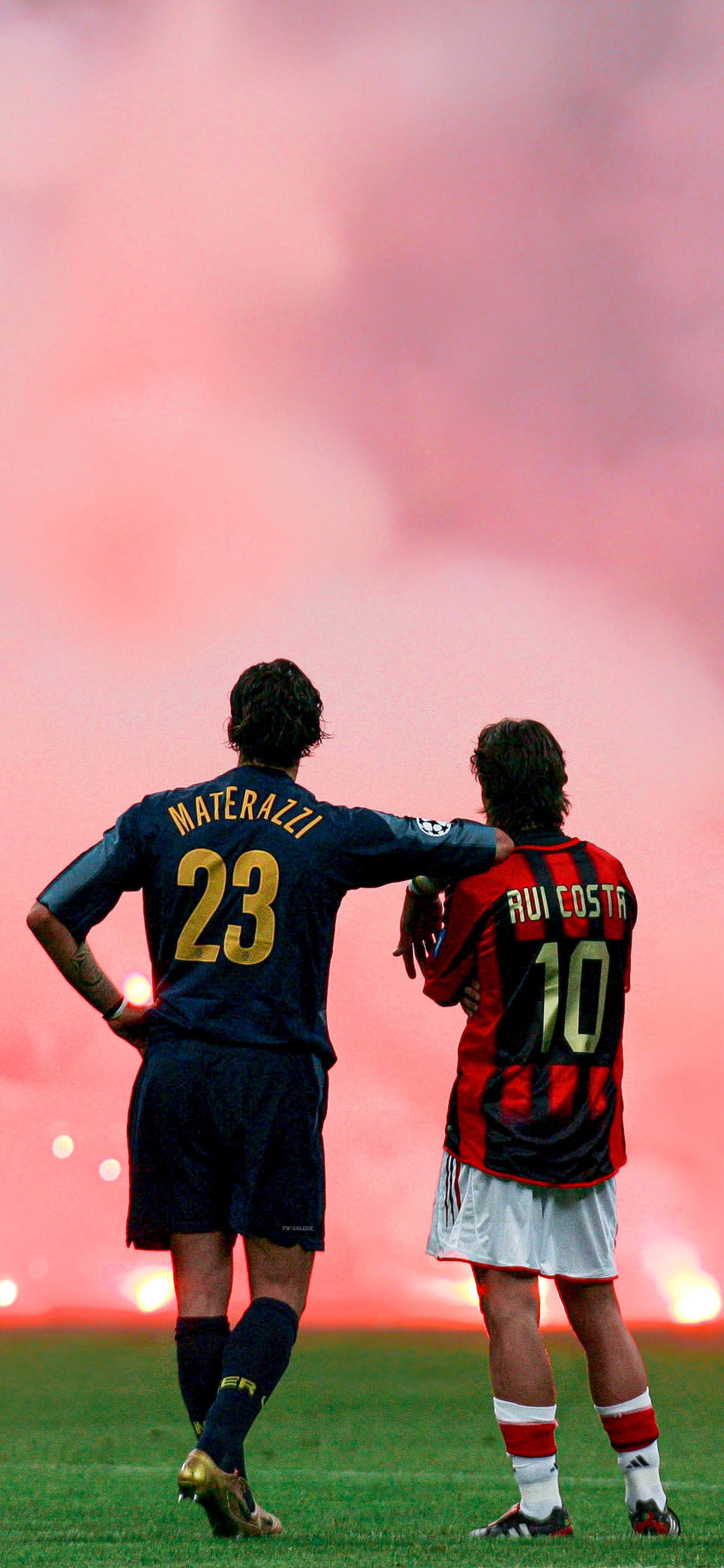
Honestly, if you’ve spent more than five minutes on football Twitter or scrolled through any "top 10 iconic photos" thread, you’ve seen it.
The smoke. That hellish, glowing red haze. And there, right in the middle of the chaos, are two men who should be at each other's throats. Instead, you have Marco Materazzi, the ultimate defensive "bad boy," casually leaning his elbow on the shoulder of Rui Costa, Milan’s elegant Portuguese playmaker. It looks like they’re waiting for a bus in the middle of a war zone.
But what actually happened on April 12, 2005?
Because the reality wasn't a peaceful moment between friends. It was a total breakdown of order at the San Siro that ended with a goalkeeper in the hospital and a stadium on fire.
The Night the San Siro Burned
This wasn't just any game. It was the "Derby della Madonnina" in the Champions League quarter-final second leg. Milan had won the first leg 2-0. Inter were desperate. They were trailing 1-0 in the second leg (3-0 on aggregate) when Esteban Cambiasso headed the ball into the net in the 71st minute.
The referee, Markus Merk, blew his whistle. No goal. He called a foul by Julio Cruz on the Milan keeper, Dida.
That was the spark.
The Inter fans in the Curva Nord didn't just boo; they revolted. Within seconds, a literal rain of plastic bottles and lit flares cascaded onto the pitch. One of those flares, a red burning missile, struck Dida directly on his right shoulder. He went down. He suffered first-degree burns. It was ugly.
Why Materazzi and Rui Costa Just Stood There
As the game was suspended and the players were shuffled toward the center of the pitch for safety, the stadium turned into something out of Dante’s Inferno.
While most players were frantic or arguing with officials, Materazzi and Rui Costa just... stopped. They stood there, side-by-side, watching the Curva Nord self-destruct.
Photographer Stefano Rellandini, working for Reuters that night, caught the split second where Materazzi leaned on his rival. He’s since said he took nearly 900 photos that day, but only one frame had that exact lean.
"It felt like time had stuck," Rellandini later recalled. "Materazzi put his elbow on Rui Costa for a few seconds which said to me: 'Time to take a rest, this is crazy.'"
It’s the contrast that makes the photo legendary. You’ve got the 6'4" Materazzi—a guy who would eventually get headbutted by Zidane and was known for being a "hard man"—resting on Rui Costa, the "Artist." They were the personification of the rivalry’s two extremes: the grit and the grace.
The Fallout Most People Forget
Everyone loves the photo, but the actual aftermath was a disaster for Italian football.
- The Match Abandoned: Merk tried to restart the game after 26 minutes, but the flares started raining down again immediately. He called it off.
- The Forfeit: UEFA didn't mess around. They awarded AC Milan a 3-0 default win, making the aggregate score 5-0.
- The Punishment: Inter Milan was hammered. They were fined roughly $250,000 (the highest fine in UEFA history at the time) and ordered to play their next four European matches behind closed doors.
- The Revenue Loss: Playing in an empty stadium cost the club an estimated €8 million in lost ticket sales.
It’s wild to think that out of a moment that almost ruined Inter’s reputation for a decade, we got the most "aesthetic" photo in the history of the sport.
What This Image Actually Represents
There’s a common misconception that Materazzi and Rui Costa were best friends. They weren't. They were rivals who respected the game enough to know when the "war" had gone too far.
The photo doesn't show a friendship as much as it shows shared exhaustion. It’s two professionals looking at the madness and realizing that, at the end of the day, it's just a game.
Kinda poetic, right?
If you want to truly appreciate the weight of that 2005 Derby, you have to look past the red smoke. Look at the body language. It’s the silence in the middle of a riot.
How to see the legacy of this moment today:
- Watch the footage: If you’ve only seen the still photo, go find the video of Dida getting hit. It changes how you see the "peaceful" lean.
- The Photographer's Work: Look up Stefano Rellandini’s other work from that night; it’s a masterclass in sports journalism under pressure.
- The "New" Versions: Fans often recreate this with modern stars like Lukaku and Leao, but nothing touches the original's grit.
Next time you see that photo on a T-shirt or a bedroom poster, remember it wasn't a pre-planned pose. It was a brief truce in a stadium that was literally on fire.