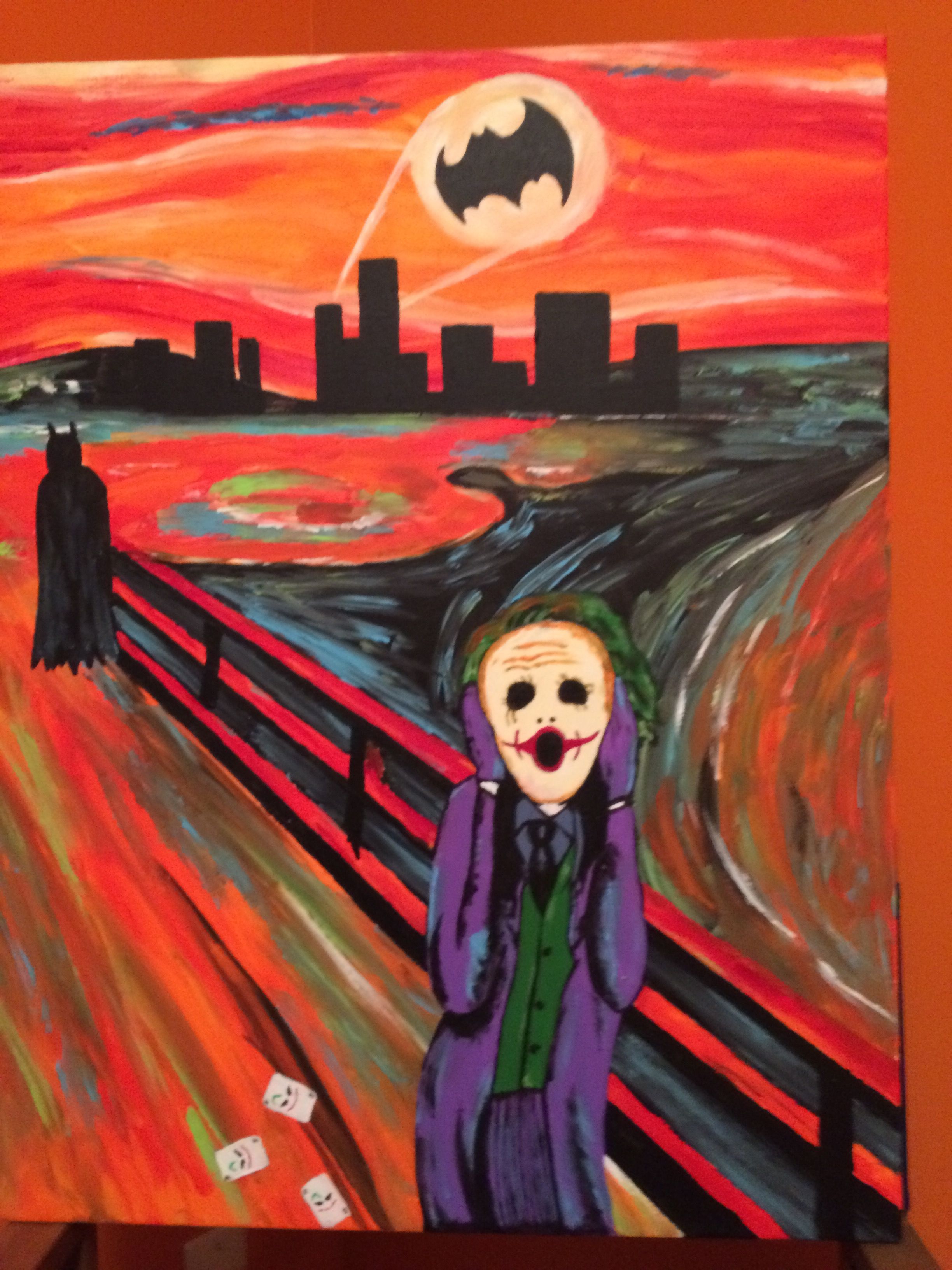
You know the image. It’s everywhere. It is the universal emoji for "I’m losing my mind." Most people call it the painting of man screaming, but honestly, if you walked up to a curator at the National Museum in Oslo and said that, they might gently correct you.
The figure in Edvard Munch’s masterpiece isn’t actually making a sound. He’s hearing one.
It sounds like a pedantic art school distinction, but it changes everything about how you look at the canvas. That wavy, amber sky and the vibrating blue water aren't just pretty colors; they are a visual representation of a panic attack. Munch wasn't painting a guy yelling at the top of his lungs. He was painting a man trying to block out the "infinite scream" of nature.
What Edvard Munch Actually Saw on That Bridge
Art history isn't just about brushstrokes. It's about a specific Tuesday in 1892. Munch was walking along a path in Ekeberg Hill, overlooking Oslo (then called Christiania), with two friends. The sun started setting. Suddenly, the sky turned blood red.
He felt a "touch of melancholy." He stood there, trembling with anxiety, while his friends kept walking.
In his diary, Munch wrote about how he felt a "great, infinite scream pass through nature." He didn't open his mouth. He covered his ears. This is why the painting of man screaming has those iconic, skeletal hands pressed against the side of its head. The figure is a victim of a sensory overload so intense that the entire landscape starts to warp and bend under the pressure of the noise.
If you look at the original 1893 version—the one with the tempera and pastel—you’ll see a tiny, barely visible inscription in the top left corner. It says: "Can only have been painted by a madman." For a long time, people thought a random vandal did it. Nope. Infrared scans by the National Museum of Norway confirmed it was Munch’s own handwriting. He knew how he sounded. He knew how it looked.
The Viral Nature of Existential Dread
Why does this image stick? We have thousands of masterpieces, but the painting of man screaming is the one that ended up on coffee mugs, socks, and in the Scream horror movie franchise.
Basically, it's the first true "modern" painting. Before Munch, art was mostly about looking at things—a bowl of fruit, a rich guy in a wig, a landscape. Munch turned the camera inward. He painted how it feels to be alive and terrified.
It hits home because everyone has felt that sudden, sharp realization of their own insignificance. It's the "Sunday Scaries" dialed up to eleven.
There isn't just one version, either. Munch was a bit of an obsessive. He made four versions between 1893 and 1910. He also made a lithograph stone so he could print black-and-white copies for the masses. He wanted people to see this. He was essentially creating a 19th-century meme.
The Stolen History
People love stealing this painting. It’s a bit of a hobby for European art thieves.
In 1994, on the opening day of the Winter Olympics in Lillehammer, two guys climbed a ladder, smashed a window at the National Gallery, and grabbed the 1893 version. They left a note that said, "Thanks for the poor security." Honestly, the audacity is impressive. It was recovered three months later in a sting operation.
Then, in 2004, masked gunmen walked into the Munch Museum in broad daylight and ripped the 1910 version off the wall while tourists watched in horror. That one took two years to find. When they finally got it back, it had moisture damage and a tear. Conservators did their best, but if you look closely at the bottom-left corner of that version today, you can still see the scar of its kidnapping.
The Science of the "Blood Red" Sky
For years, people just thought the red sky was a metaphor for Munch’s mental state. But some researchers think he was being literal.
In 1883, the Krakatoa eruption in Indonesia sent a massive cloud of volcanic ash around the globe. It caused vivid, terrifyingly red sunsets in Norway for months. Munch would have seen them. Imagine being a sensitive, already anxious artist and seeing the sky literally turn the color of blood for half a year. It would stay with you.
Others argue they were "nacreous clouds"—rare, high-altitude clouds that look like mother-of-pearl and appear in cold climates like Norway. They can look incredibly eerie and wavy, just like the sky in the painting of man screaming.
Whether it was a volcanic explosion or a rare weather event, Munch used that real-world terror to anchor his internal ghost story.
Why You Should Care Today
We live in an era of constant noise. We are bombarded by notifications, news cycles, and the "infinite scream" of the internet. When you look at the painting of man screaming, you’re looking at the first person to ever capture what it feels like to be overstimulated by the world.
It’s not just a "famous old painting." It’s a mirror.
How to Experience Munch Without a Plane Ticket to Oslo
If you want to understand the power of this work, don't just look at a digital thumbnail. It doesn't work that way. The scale and the texture matter.
- Look for the Lithograph: Find a high-resolution scan of the black-and-white lithograph version. Without the "blood" sky, the focus shifts entirely to the vibrating lines around the head. It's much more claustrophobic.
- Check the Pencil Version: One of the versions is done in pastel. It’s softer, which somehow makes the subject's face look even more ghostly and fragile.
- Contextualize the Bridge: The bridge in the painting was a known spot for suicides at the time. It was also near a slaughterhouse and a psychiatric hospital where Munch’s sister was staying. When you know that, the "scream" feels much more grounded in a specific, painful reality.
The best way to appreciate it is to stop seeing it as a pop-culture icon and start seeing it as a diary entry. Munch wasn't trying to be famous. He was trying to stay sane by putting his fear on a piece of cardboard.
To truly "get" the work, find a high-quality print or a digital archive—like the ones provided by the Munch Museum—and zoom in until you can see the grain. You’ll notice that the brushstrokes don't follow the objects; they follow the emotion. The bridge is straight and "rational," but the person and the water are melting. That’s the whole point. Rationality is a thin bridge we walk on while the rest of the world is screaming.
Next Steps for Art Lovers
If you're interested in exploring the darker side of Art History beyond the painting of man screaming, your next move should be looking into Francisco Goya’s "Black Paintings." Specifically, Saturn Devouring His Son. While Munch’s work is about the anxiety of the modern world, Goya’s work is about the literal darkness of the human soul. You can also visit the Google Arts & Culture platform to take a 360-degree tour of the Munch Museum's collection, which lets you see the scale of these works in a way a standard photo cannot replicate.